
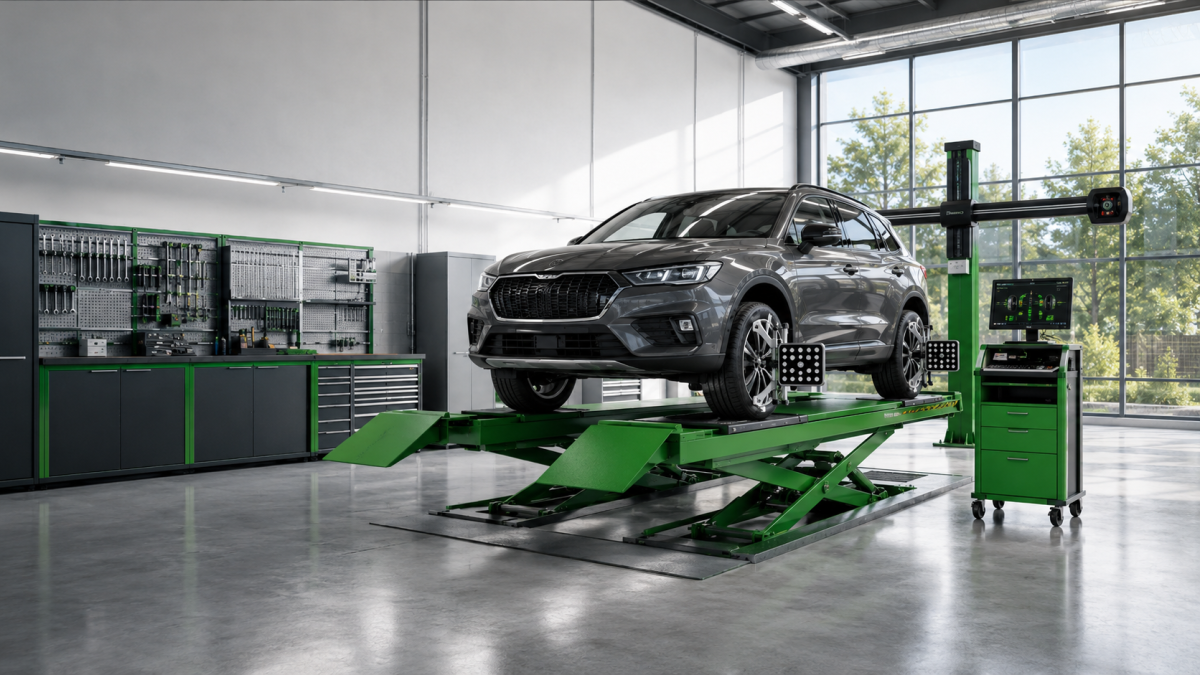
Which Car Lift Is Best for Wheel Alignment?
Wheel alignment requires more than simply raising a vehicle off the floor.
The vehicle must be positioned correctly, the wheels must be able to move as required during measurement and adjustment, and the platform supporting the vehicle must remain level.
That is why an ordinary service lift and an alignment lift should not automatically be treated as the same equipment.
## Start With the Alignment Process
During wheel alignment, the vehicle normally remains supported by its wheels.
The technician needs access to the suspension and steering adjustment points while the alignment system measures wheel angles.
This means the lift needs to support both:
– accurate vehicle positioning;
– technician access underneath the vehicle.
For this reason, drive-on alignment lifts are commonly used.
## Four-Post Alignment Lifts
A four-post alignment lift is a common option for a dedicated alignment bay.
The vehicle drives onto two runways and remains supported by its tires.
An alignment-ready configuration may include:
– front turntables;
– rear slip plates;
– long and level runways;
– suitable wheelbase range;
– optional rolling or bridge jacks.
The turntables allow the front wheels to steer during alignment procedures, while rear slip plates allow controlled wheel and suspension movement.
A standard four-post service lift should not automatically be assumed to include these features.
Explore:
[Four-Post Lifts](/products/four-post-lifts/)
## Alignment Scissor Lifts
An alignment scissor lift can provide a different workshop layout while still supporting wheel-alignment work when designed for that purpose.
It may be useful where the workshop prefers:
– fewer vertical columns around the bay;
– a different technician access pattern;
– a compact alignment-bay layout;
– an alignment-specific scissor configuration.
The important point is not simply that the equipment is a scissor lift.
It must be designed or configured for wheel alignment.
Explore:
[Scissor Lifts](/products/scissor-lifts/)
## Why Turntables Matter
During alignment procedures, the front wheels need to steer and rotate without being restricted by the runway surface.
Turntables provide a low-friction surface for this movement.
When comparing alignment lifts, check:
– turntable position;
– usable vehicle wheelbase range;
– runway layout;
– compatibility with the alignment work being performed.
## Why Slip Plates Matter
Rear slip plates allow controlled movement between the tires and the runway.
This helps the suspension settle naturally during measurement and adjustment.
They are one of the features that can distinguish an alignment-ready runway from a basic drive-on platform.
## Platform Level Is Important
Correct installation and platform level are particularly important in an alignment bay.
The lift should be:
– installed on a suitable foundation;
– correctly positioned;
– correctly leveled;
– maintained according to the equipment requirements.
The alignment machine and lift work together as part of the service process.
## What About Two-Post Lifts?
Two-post lifts are widely used for general mechanical repair because they provide strong access to:
– wheels;
– suspension;
– underbody;
– steering components.
However, they are generally not the normal choice for performing wheel alignment with the vehicle resting on its tires.
A workshop may still use a two-post lift for suspension or steering repair before the vehicle moves to the alignment bay.
Explore:
[Two-Post Lifts](/products/two-post-lifts/)
## What Should You Compare?
Before choosing an alignment lift, compare the following.
### Vehicle Range
What types of vehicles will enter the alignment bay?
Consider passenger cars, SUVs, pickups and other vehicles regularly serviced.
### Rated Capacity
The lift must be suitable for the vehicles the workshop intends to service.
### Wheelbase Range
Check whether the runway and alignment components accommodate the required vehicle wheelbases.
### Turntables and Slip Plates
Confirm whether the selected configuration includes the components required for the intended alignment workflow.
### Runway Dimensions
Vehicle track width and overall dimensions should fit the lift comfortably.
### Installation and Leveling
The workshop floor and installation conditions must meet the requirements of the selected equipment.
### Secondary Lifting
If technicians need to raise an axle or remove load from the wheels, consider whether auxiliary or rolling jacks are required.
## A Simple Selection Guide
| Workshop Need | Lift Type to Investigate |
|—|—|
| Dedicated wheel-alignment bay | Four-post alignment lift |
| Alignment bay with scissor layout | Alignment scissor lift |
| General mechanical repair | Two-post or general service lift |
| Alignment plus wheel-free service | Alignment lift with auxiliary lifting |
Explore:
[Wheel Alignment Lifts](/products/wheel-alignment-lifts/)
[Wheel Alignment Application](/applications/wheel-alignment/)
## Before Requesting a Recommendation
Prepare:
– vehicle types;
– maximum vehicle weight;
– typical wheelbase range;
– workshop bay dimensions;
– alignment equipment type;
– whether auxiliary lifting is required;
– known floor conditions.
This information makes it easier to compare suitable alignment-lift configurations.
## Need Help Choosing an Alignment Lift?
If you already know your vehicle range, bay dimensions and alignment workflow, include those details with your inquiry.
DAYI can then help identify relevant lift categories and models based on the available product specifications.
[Get a Quote](/get-a-quote/)